


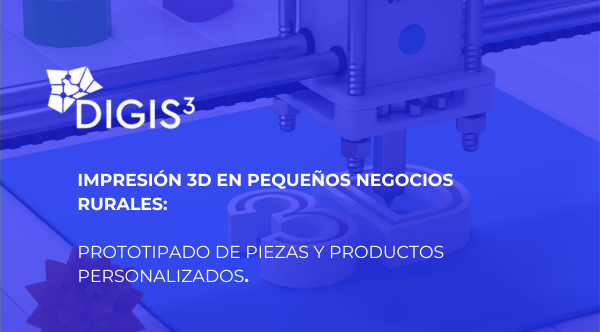
3D printing technology is no longer an exclusive tool for large industries and innovation centers. Today, its accessibility and versatility allow small businesses located in rural areas to benefit from its multiple advantages, especially in prototyping, product customization, and low-volume manufacturing.
For SMEs in Castilla y León, this technology represents a clear path to increase competitiveness, reduce development costs, and shorten production times—offering a strategic advantage in sectors such as crafts, agricultural mechanics, tourism, agri-food, and healthcare.
Common challenges for small rural businesses
Small businesses face structural barriers that hinder the adoption of advanced technologies like 3D printing. The lack of specialized suppliers, limited technical knowledge, and restricted access to training and equipment prevent many SMEs from leveraging this tool to innovate and grow. Identifying these challenges is the first step toward designing solutions tailored to their real needs:
Scarcity of nearby technology providers.
Lack of technical knowledge about 3D printing.
Limited access to specialized training and equipment.
Difficulties in customizing products or developing prototypes without high costs.
What advantages does 3D printing offer businesses?
3D printing opens up new possibilities, enabling businesses to manufacture customized products, reduce costs, and improve responsiveness to market demands. This technology democratizes access to innovation, offering tangible benefits across various sectors and promoting more sustainable and efficient production models:
Rapid prototyping to validate business ideas or develop new products without relying on third parties
Product customization: from agricultural components to unique tourist souvenirs tailored to customer needs
Inventory reduction through on-demand manufacturing
Savings in transport and logistics by locally producing parts that previously had to be imported
Promotion of the circular economy using recyclable or biodegradable materials
Real use cases
Beyond theory, there are numerous examples of how 3D printing is already transforming small business activities. From mechanical workshops creating unique parts to artisans designing custom molds, these cases show that technology can adapt to local contexts and generate economic, social, and environmental value:
Rural mechanical workshops designing and manufacturing specific parts for obsolete agricultural machinery
Artisan companies creating custom molds for ceramic or food products
Tourism businesses offering keychains, decorative items, or unique 3D-designed souvenirs
Local repair services reducing wait times and costs by producing custom spare parts
How can DIGIS3 help?
At DIGIS3, we offer comprehensive support for adopting additive manufacturing technologies, including:
Free digital maturity assessments
Proofs of concept to validate solutions before implementation
Guidance in finding funding and grants
Connections with technology providers and specialized centers
We help businesses integrate technologies like 3D printing to improve efficiency, create more competitive products, and strengthen local development.