


Quantum computing is no longer a distant promise but an emerging reality that can transform how we solve complex problems in sectors such as agriculture, energy, and logistics. Although it is still in its early stages of practical application, its potential is especially relevant for agri-food, industrial, or distribution cooperatives operating in Castilla y León.
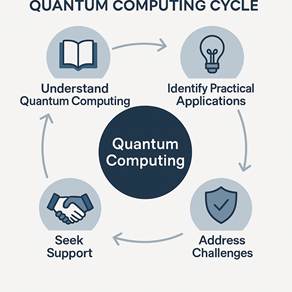
What Is Quantum Computing and Why Does It Matter?
Unlike traditional computing based on bits, quantum computing is based on qubits, which can represent multiple states simultaneously. This allows calculations that would take a classical computer years to be solved in seconds. This capability can be applied to:
In the Rural Sector:
- Optimization of transport routes and logistics chains.
- Advanced crop and weather forecasting using complex meteorological models.
- Development of new fertilizers or sustainable materials at the molecular level.
- Market simulation and improvement of commercial strategies in agricultural cooperatives.
In the Industrial Sector:
- Optimization of production processes, reducing downtime and improving energy efficiency.
- Design of new materials with specific properties, useful in sectors such as automotive, construction, or agricultural machinery.
- Simulation of complex chemical or physical processes, accelerating product innovation.
- Advanced supply chain management, anticipating disruptions and improving resilience.
- Quantum cybersecurity, a new frontier to protect sensitive industrial data.
Challenges and Barriers for Cooperatives
Despite its benefits, cooperatives face specific obstacles:
- Lack of knowledge about real applications.
- Lack of technical training in their teams.
- Limited access to quantum tools or testing environments.
- The feeling that “it doesn’t affect them yet.”
Concrete Benefits for Rural and Industrial Cooperatives
The use of quantum computing, although still emerging, can mean:
- Reduced operational costs thanks to better predictions and optimization.
- Greater competitiveness by incorporating innovative solutions.
- Early adaptation to technologies that will be key in the next 10 years.
- Attraction of young talent interested in emerging technologies applied to their environment.
- Boost to sustainability by enabling more efficient and less polluting processes.
How Can DIGIS3 Help You?
At DIGIS3, we facilitate access to disruptive technologies such as quantum computing through:
- Free technological diagnostics tailored to your cooperative’s level of digitalization.
- Sector-specific workshops on emerging technologies with practical applications.
- Free proof-of-concept trials, thanks to European support.
- Access to experts and technological alliances, through our partners such as the Castilla y León Supercomputing Center.
The key is to start exploring today what will be standard tomorrow. We help you take the first step, with no prior knowledge or initial investment required.